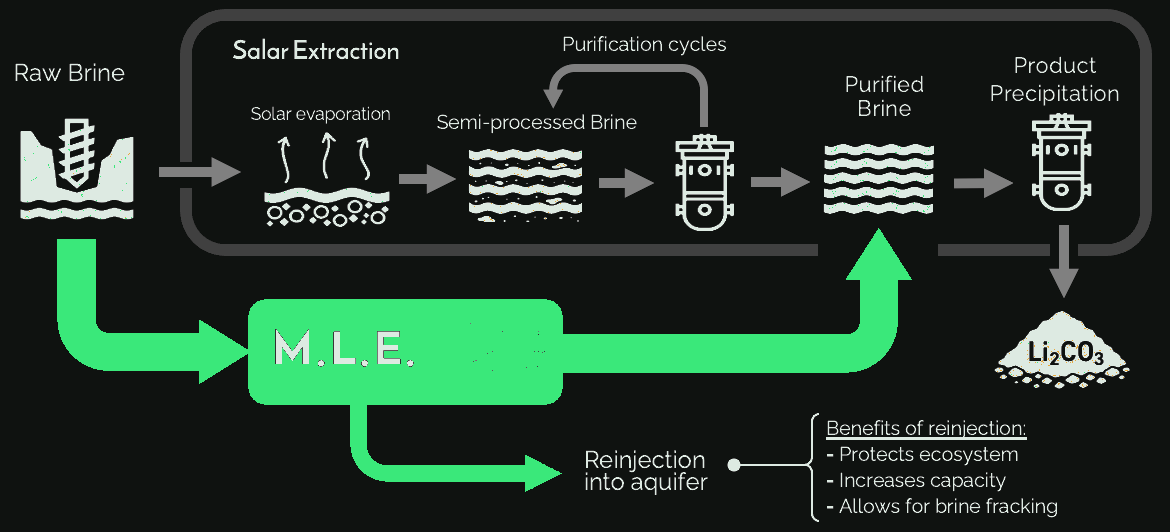
Separate lithium from competing ions at any concentration, from 0.17 ppm seawater to 30,000 ppm refinery brine. Continuous operation. No evaporation. No batch chemistry.
>80%
Li Recovery
−39%
OpEx per m³ feed
−95%
Chemical Usage
Membrane Lithium Extraction (M.L.E.) captures the Li that conventional evaporation and purification methods leave behind, lifting recovery from typical 25–50% baselines to over 80%, generating more product for the same asset.
Continuous, RO-style cascade replaces multi-step purification trains, reducing reagent use, footprint, and labour. Modular skids can be deployed rapidly, allowing flexible ramp-up for dynamic conditions.
By employing greenLi's patent-pending Li-selective membrane, M.L.E. purifies brines without the precipitants of conventional processing, the acidic eluants of conventional Direct Lithium Extraction (D.L.E.), or any associated transport costs.
Figures based on internal modelling and bench-scale validation against salar brine processing baselines.
When combined with the right pre-treatment, M.L.E. operates across the full salinity spectrum, from ultra-dilute seawater to concentrated refinery wastewater. The same modular hardware, every feed.
See All ApplicationsM.L.E. operates as a continuous flow process. Feed water enters the system, passes through stacked membrane modules, and exits with lithium concentrated on the permeate side. Competing ions (sodium, magnesium, calcium, boron) are rejected.
The membrane is developed at Tel Aviv University and manufactures through established desalination supply chains, which means scale-up does not depend on a new factory. Separate lithium from competing ions at any concentration, from 0.17 ppm seawater to 30,000 ppm refinery brine.
Conventional D.L.E. works on a narrow band of feed conditions. Concentration above roughly 200 ppm. Temperatures below 40 degrees Celsius. Stable chemistry. Anything outside that band fails or operates at uneconomic recovery.
M.L.E. is different. It is bound by throughput, not by concentration. That has three consequences:
Low-concentration assets become viable. Groundwater at 20 ppm produces meaningful lithium output when flow is high enough.
High-temperature streams become viable. M.L.E. operates up to 70 to 80 degrees Celsius, which is the only way to handle geothermal return water at 60 degrees Celsius.
High-volume assets gain capacity. By recovering over 80 percent of available lithium, versus the 25 to 50 percent typical of evaporation, and running continuously rather than through an 18-month cycle, the same brine resource yields meaningfully more lithium per year.
Most D.L.E. methods rely on ion-exchange resins, which run in batch cycles and depend on chemical regenerants. M.L.E. replaces that approach with a continuous membrane platform that outperforms across the criteria that matter for commercial deployment.
COTS = Commercial-Off-The-Shelf.
Q3 2026
Trial Manufacture
TRL 4 → 6
Q4 2026
Test Pilot Deployment
TRL 6 → 8
Q2 2027
Commercial Pilot Deployment
TRL 8 → 9
Q4 2027
Commercial Scale-Up
TRL 9
Share your water chemistry. We model expected recovery and capacity before any lab work.