D.C.M. Direct Cathode Manufacture

Direct Cathode Manufacture.

A proprietary process that converts purified lithium into battery-ready cathode powder on site. Operators of lithium assets capture margin that today flows to refiners and cell manufacturers.

Request a Simulation ← Back to Overview

Chemistry Agnostic

NMC, LFP, LMFP, NCA and beyond

23×

Value uplift vs raw brine

Bolt-on

Integrates with existing mines or DLE

The D.C.M. Opportunity

Multiply the value of every Li atom.

The saleable value of lithium multiplies exponentially through the conventional supply chain. Conventional operation limits the revenues of Li asset owners to low-value intermediary salts. D.C.M. empowers proprietors to access the full price point with minimal relative cost.

$28k

Li₂CO₃

1 ton
Li Carbonate

$75k

LiOH·H₂O

1.14 ton
Li Hydroxide

$110k

Cathode
precursor

4.27 ton
Raw Bulk Cathode

$235k

Refined
cathode

4.27 ton
Semi-refined Cathode

$655k

Battery-ready

4.48 ton · D.C.M. output

Conventional Revenue

Li asset owners typically exit at Li₂CO₃ or LiOH, capturing only the first $28k–$75k per ton equivalent.

Revenue with D.C.M.

$655k per ton equivalent. D.C.M. empowers Li asset owners to access the full price point.

The Supply Chain Problem

The supply chain leaves money on the table.

Today, lithium asset operators sell carbonate or hydroxide into a refining market they do not control. Refiners convert that into cathode precursor. Cathode manufacturers convert that into cathode powder. The margin compounds at every step. Asset operators see none of it.

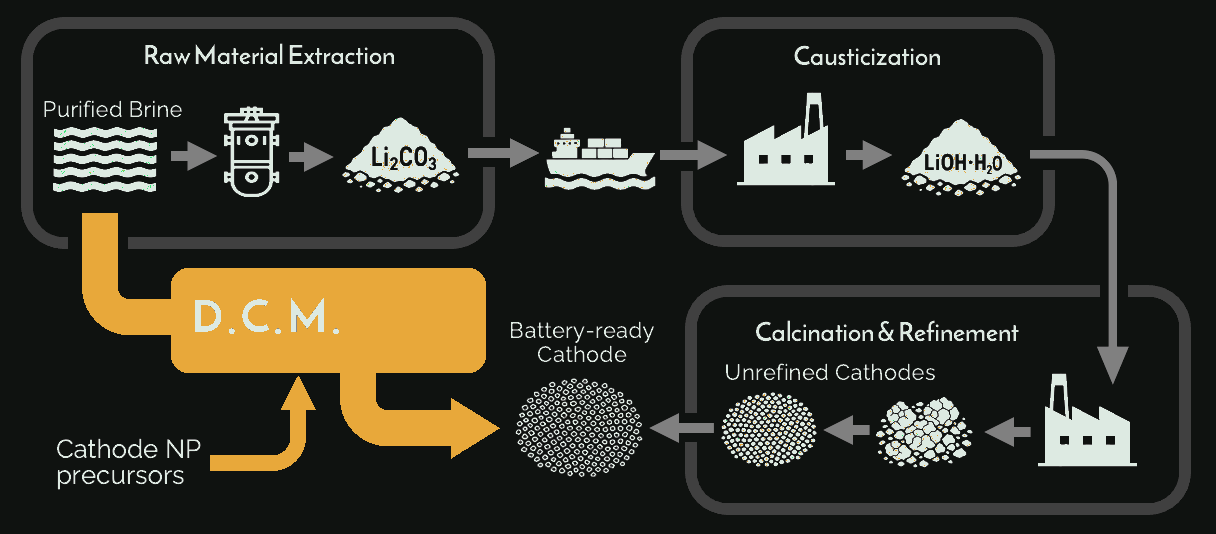
D.C.M. collapses that chain. Lithium goes from purified permeate to battery-ready cathode powder in a single integrated process, on site.

How It Works

Two proprietary steps.

Step 1: Solid-phase capture. Purified lithium from any aqueous feed is concentrated onto a proprietary solid-phase capture material. This material is the bridge between the aqueous separation step and the solid cathode product. Note: M.L.E. and D.C.M. can be deployed independently or together — the feed source is not a determining factor. Both technologies are agnostic to chemistry and feed type.

Step 2: Cathode transfer. The captured lithium is transferred directly onto cathode precursor material. The output is a battery-ready cathode powder, chemistry-matched to the customer's specification. There is no intermediate salt, no transport to a refiner, no conversion plant.

D.C.M. process flow diagram
The Vertical Integration Case

Vertical integration without a refinery.

D.C.M. lets operators sell into the cathode market directly, capture refining margin in-house, and avoid building or contracting a refinery. It is agnostic to cathode chemistry, which means the same platform can output LFP, NMC, or future chemistries as the market shifts.

Three structural advantages:

Margin: capture multiple stages of the supply chain in a single integrated facility

Chemistry Agnostic: M.L.E. and D.C.M. are both agnostic to feed chemistry — switch cathode chemistries without rebuilding, and deploy on any aqueous lithium source

Resilience: reduce dependency on geographically concentrated refining capacity

Unique Benefits

What D.C.M. delivers.

Chemistry Agnostic

D.C.M. is not locked to a single cathode chemistry. NMC, LFP, LMFP, NCA, and emerging chemistries can all be produced. The client or open market dictates the cathode spec.

Vertical Integration

Proprietors of Li assets can go directly from brine to battery-ready cathode on-site. D.C.M. captures the value that conventional supply chains distribute across multiple intermediaries.

Open Market Access

Certified battery-ready cathode material can be sold directly to battery manufacturers worldwide at $655k per ton equivalent, compared to $28k for raw Li₂CO₃.

Superior Material Quality

Uniform crystal structure, monodisperse particle distribution, and optional co-manufacture of graphene coating, producing cathode material that meets and exceeds market specifications.

Autonomous Operation

D.C.M. is designed for on-site, autonomous operation. Minimal staffing requirements, modular design, and remote monitoring allow deployment in remote or resource-constrained locations.

Bolt-on Deployment

D.C.M. integrates directly with existing mines, DLE systems, or M.L.E. output. No need to reconfigure upstream operations. D.C.M. plugs into the purified brine stream.

Market Position

A category with no direct competition.

There is no known direct competitor in continuous brine-to-cathode production. The conventional supply chain requires 4–6 separate industrial steps, each performed by a different company in a different geography.

D.C.M. collapses this chain, allowing Li asset owners to control output quality, timing, and chemistry specification independently of external refining capacity.

Conventional approach

Brine Li₂CO₃ LiOH pCAM (precursor Cathode Active Material) CAM (Cathode Active Material)

4–6 distinct industrial actors. 18–36 months supply lead time. Fixed chemistry output per refinery.

With D.C.M.

Purified brine Battery-ready CAM (Cathode Active Material)

1 system. On-site. Configurable to any cathode chemistry. Open market or captive supply.

Development Timeline

D.C.M. from proof to commercial scale.

Q3 2026

Desk Pilot Demo

TRL 3 → 5

Q1 2027

Test Pilot Deploy

TRL 5 → 6

Q3 2027

Pilot Scale-Up

TRL 6 → 7

Q1 2028

Commercial Pilot

TRL 7 → 9

Q3 2028

Commercial Scale-Up

TRL 9

Intellectual Property

Protected at every step.

Solid-phase Capture Material

Proprietary material concentrates lithium from the enriched permeate stream for direct integration with cathode manufacture. No known direct competition at this step.

Cathode Transfer Process

Proprietary process transfers captured lithium directly onto cathode material on-site. Eliminates intermediate transport and chemical conversion. No known direct competition.

D.C.M. Pilot

Want to understand if D.C.M. fits your operation?

Share your asset profile. We will walk through how vertical integration changes your economics.

Request a Simulation Explore M.L.E. →